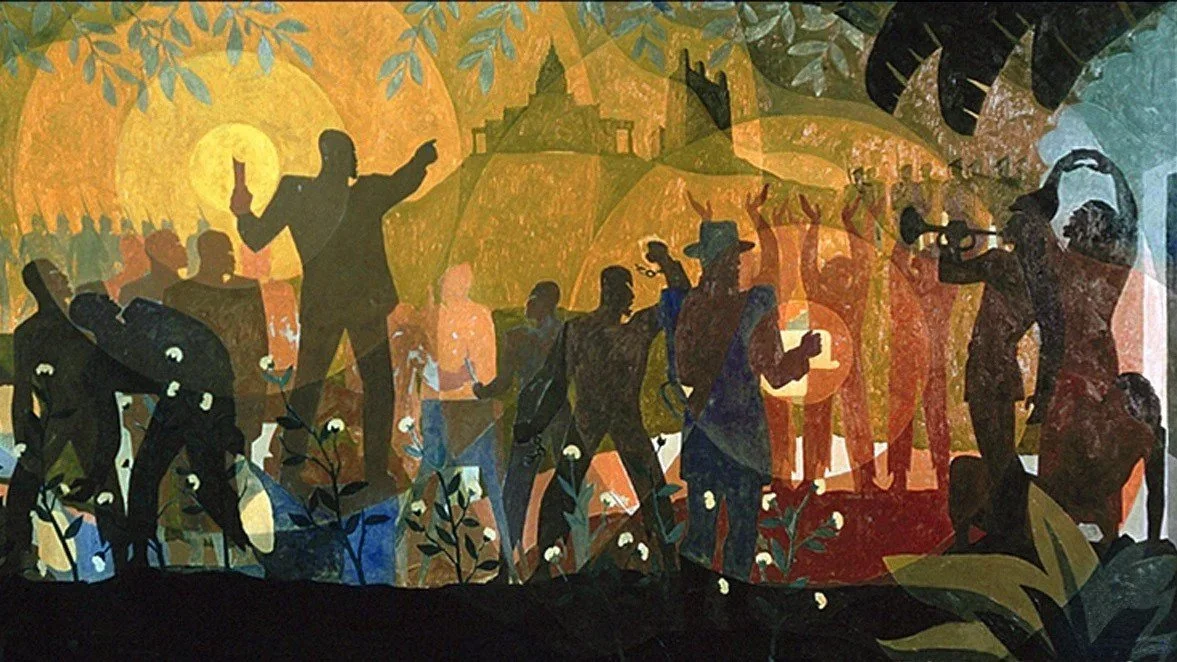
Aaron Douglas (American, 1899–1979), Aspects of Negro Life: From Slavery to Reconstruction, 1934. Oil on canvas, 60 in. x 11 ft. 11 in. (152.4 x 363.2 cm).
On April 29, 2026, the Supreme Court of the United States (SCOTUS) effectively destroyed the vestiges of the 1965 Voting Rights Act (VRA) in the case Louisiana v. Callais. Immediately afterward, southern states like Georgia, Florida, Tennessee (and of course, Louisiana) submitted congressional maps that would disenfranchise the Black voters of those states. Now, I am no big-city lawyer, but in short, the takeaway from this decision is that congressional maps, which are drawn by political parties in the states to determine the number of districts in a given state, can now be drawn in ways that could rob Black people and other minorities, of representation. Since the passage of the Civil Rights Laws of the 60s, Black people have generally supported the Democratic Party because the party was in power when the Civil Rights Act was passed.
Both the Civil Rights Movement and, some would say, the modern Environmental Justice Movement were birthed in large part by Black people from the South. We can even throw in the abolitionist movements that eventually led to the 13th, 14th, and 15th amendments, which, about a century later, gave the US an actual pretense of democracy. I've written about my complicated relationship with the South before, and where I saw a possibility to advance climate and environmental protections into state, if not eventually federal law (that is, if states with the potential to turn purple or blue, like Georgia and Texas, and secure more congressional and senate seats). Now, I have a deep worry for my people, as over half of us live there. The same reason my family, and so many other Black American families, moved north or west, namely Jim Crow, seems to be making a comeback.
I wish I were just being dramatic, but political representatives, judges, and government officials who were presuadable to be sympathetic to the causes of Black people were instrumental in creating the societal conditions even to have a Civil Rights or Environmental Justice Movement. Take Drs. Beverly Wright and Robert Bullard are two academic pioneers of the EJ movement from the South (Louisiana and Texas, respectively). I have met and worked with both of them, and my impression is that even if they had not reached the pinnacle of academic achievement, they would still have been champions of the EJ movement. However, their university journeys are interesting demonstrations of how voting and civil rights matter. Both of them went to Historically Black Colleges and Universities (HBCUs), institutions of higher learning (mostly in the South) that Black people created due to being mostly shut out of attending Primarily White Institutions (PWIs), be they public or private. The Morrill Act, passed in 1890 and named for the abolitionist Senator Justin Morrill, established “separate but equal” land-grant colleges, including Grambling, which Dr. Wright attended, and Alabama A&M and Clark Atlanta, which Dr. Bullard attended. I do not know why either of them attended HBCUs, but it is interesting to note that SCOTUS handed down its decision in Brown v. Board of Education. This decision declared segregation in public schools unconstitutional (I am sorry, Dr. Bev), only about a decade or so before they earned their undergraduate degrees.
While both of them received their educational grounding around Black people, they went on to receive their doctorates from PWI institutions, which, while probably unimaginably difficult in the 1970s, would have been even rarer in a pre-Brown United States. They would both egress from the cornfields of Iowa and the blizzards of Buffalo to their home, the Deep South, to continue the legendary advocacy and scholarship that provided intellectual and moral heft to the EJ movement.
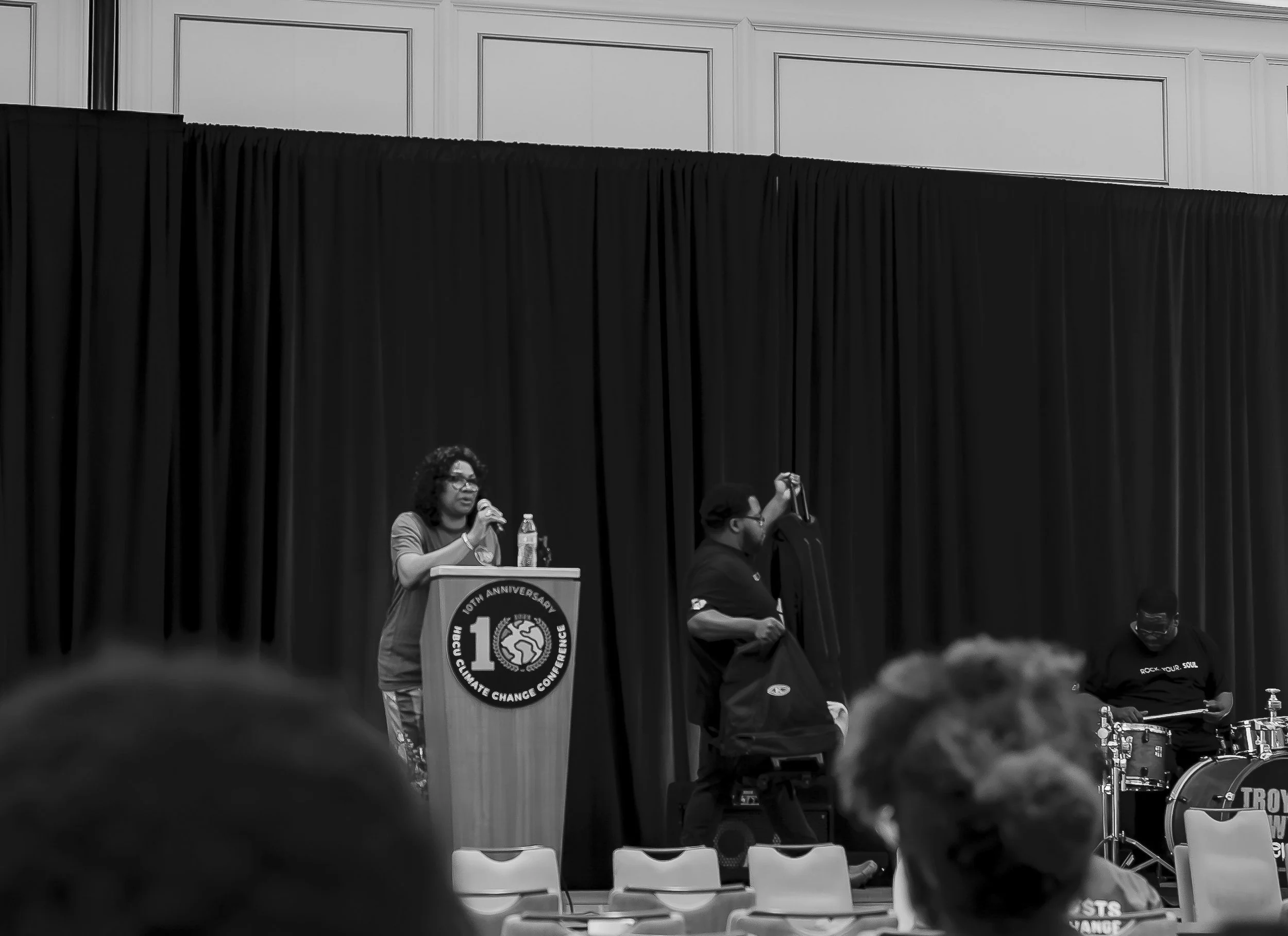
This is a photo of Dr. Beverly Wright I took at the HBCU Climate Conference she was telling us the proper way to throw ass
Both esteemed Doctors benefited, in part, from policies that politicians and the judiciary were open to supporting. I am not saying that any politician should be trusted, but it is important to have presidents who could appoint SCOTUS justices who are not openly hostile to the Voting Rights Act and civil rights for Black people. Another case in point: affirmative action in college admissions was ended under Roberts in 2023, capping off the 10-year anniversary of the Shelby County v. Holder case, the first major assault on the Voting Rights Act under the Roberts court.
The reason I bring up Drs. Bullard and Wright are to demonstrate the role that civil rights played in enabling these people to reach their full potential as credentialed academics and leaders in the fight for environmental justice for all. Again, I have no doubt either of them would have made an impact in growing the EJ movement if they didn’t have PhDs, but it certainly would have been more of an uphill battle to be recognized in policy and legal spaces as experts and taken seriously. I do not mean to say that we, as Black people, need to be recognized as “legitimate” in the eyes of the courts, Congress, and the white house. Still, we are Americans, for better or worse, and we should have access to the same rights and opportunities as any other American citizen. In spurts and stutters, our government was pressured into doing things to bring us closer to parity with our white peers. But now…to put it in a vernacular sense, we are hustling backwards as a country. The affirmative action policies that may have given both scholars a chance to change the world are effectively gone under the Roberts court- shout to Ed Blum, a fellow “friend and handmaiden to white supremacy,” to quote the legal expert Elie Mystal, who was also instrumental in getting Shelby v. Holder to the SCOTUS.
Both the social movements (EJ and Civil Rights) I have mentioned above arose due to the mass mistreatment of the Black population and our unwillingness to break under the constant assault of white supremacy; and to be more specific, Southern Black people were the vanguard of both movements, and there was crossover between key figures of both in the establishment of the EJ movement. In Luke Cole and Shelia Foster’s 2001 book, From the Ground Up: Environmental Racism and the Rise of Environmental Justice, the authors mention that the Warren County, North Carolina, protests that a number of people see as a key catalyst to defining environmental injustice and racism, saw involvement from civil rights leaders such as Benjamin Chavis, and tactically similar to the protests, marches, and other direct actions used during the struggles of the 1950s and 1960s. In addition, they speak of the late Georgia representative and proponent of “good trouble,” John Lewis, who used his platform to advocate for the 1992 Environmental Justice Act. Although this piece of legislation did not pass, it laid the foundation for Bill Clinton’s 1994 Executive Order (EO) 12898, which directed federal agencies to address adverse environmental impacts on marginalized communities. The voices of Black southerners yet again changed national policy. The EO stood for 30 years until Donald Trump, during the first day of his second presidential term, ended it, perversely claiming it violated the Civil Rights Act of 1964.
It would be easy to just blame a handful of people for the rollback of both voting rights and environmental protections. Still, the sad truth of our country is that millions of people support harming Black people, even at the expense of their own well-being. Many people voted for Presidents Bush and Trump, who then appointed five of the six judges to the SCOTUS, which has led to the loss of women’s bodily autonomy as well as the legal dismantling of the administrative state. And what SCOTUS has done to break the VRA is key to the ongoing rollback of people's rights. In my opinion, this comes from a place of fear; a fear that white people will lose control of the country and possibly those of us who have been oppressed will take revenge, because maybe that is what they feel they would do. In psychological terms, that is called projection. I will not pretend to speak for all Black people, but generally, I don’t think the Black community wants to strip the rights from white (men) people; we have fought since we were brought here to have equal treatment for ourselves and everyone else. Even with the EJ movement, it is a rainbow coalition of Native, Black, white, and Latino peoples who want everyone to enjoy clean food, air, and water. There is nothing in the 17 EJ principles that seeks to deprive white people of any sort of rights.
Things are grim, but remember that abolition, civil rights, and EJ were movements that began in the South among disenfranchised people. The resilience born of oppression in the South is the true engine of democracy in the US, and I think that is why the GOP is so dead-set against depriving Black people of their fair chance to change policy through representation. We have a fairly short time frame, but if people can organize enough to help the Democrats win the mid-term elections in both chambers this year and push the Senate to end the filibuster, there is a chance of reintroducing the VRA, or some version of it, in Congress. I am aware that is a big “If,” since a number of our representatives in Congress don’t exactly have a fire lit under their asses to save democracy.
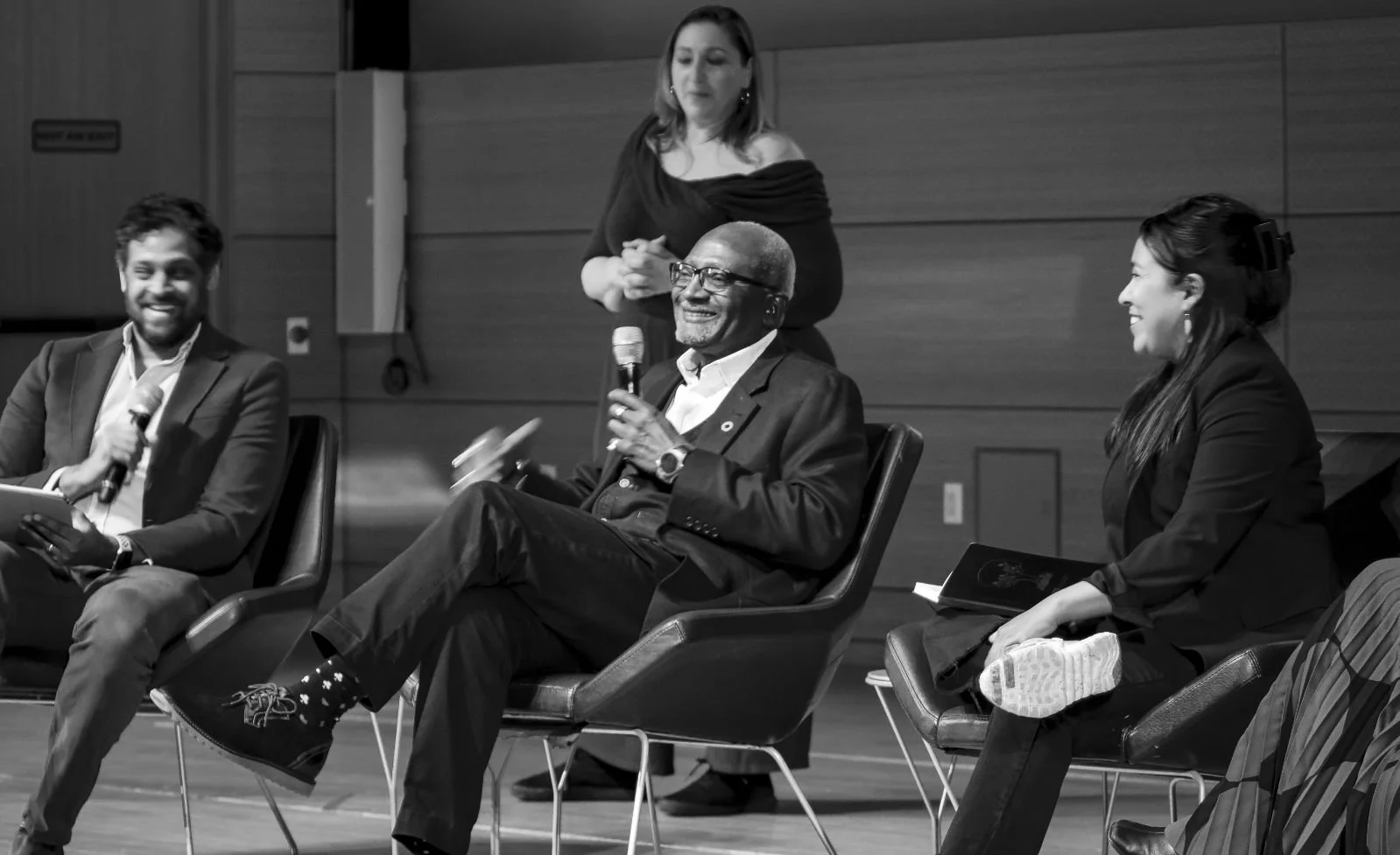
This is an image of Dr.Bullard that I took at an event I co-produced.
Thankfully, we are seeing people fighting back for both fair political representation and environmental protections in the South, and across the country. The hyperscale data center building boom is running up against resistance in communities all over the place, as people are finding out that their elected officials are not acting in their best interests when it comes to ensuring these data centers do not spew pollution and poison natural resources in already overburdened communities. The Pearson brothers, Justin and Keshaun, are leaders in the fight for political and environmental rights in Tennessee. In a recent webinar I attended, held about a week after the Callais v. Louisiana decision, Keshaun said: “We are not helpless or hopeless, Power to the People,” as he and others on the panel tied the current fight for EJ to the fight for democracy. Black Southerners have shown an unruliness that has caused the fall of chattel slavery, forced the mighty US government to provide voting, employment, and educational rights to everyone, and pushed for the biggest federal investment in EJ just a few years ago. While the GOP and the Federalist Society may feel they have won, I would never count on Black Southerners to accept defeat, even if things look bleak now. These harsh conditions, if history is to be believed, may forge new leaders and movements to push us towards the justice we deserve.
